Featured Program: Mozambique
Mozambique Multi-Client Exploration Program
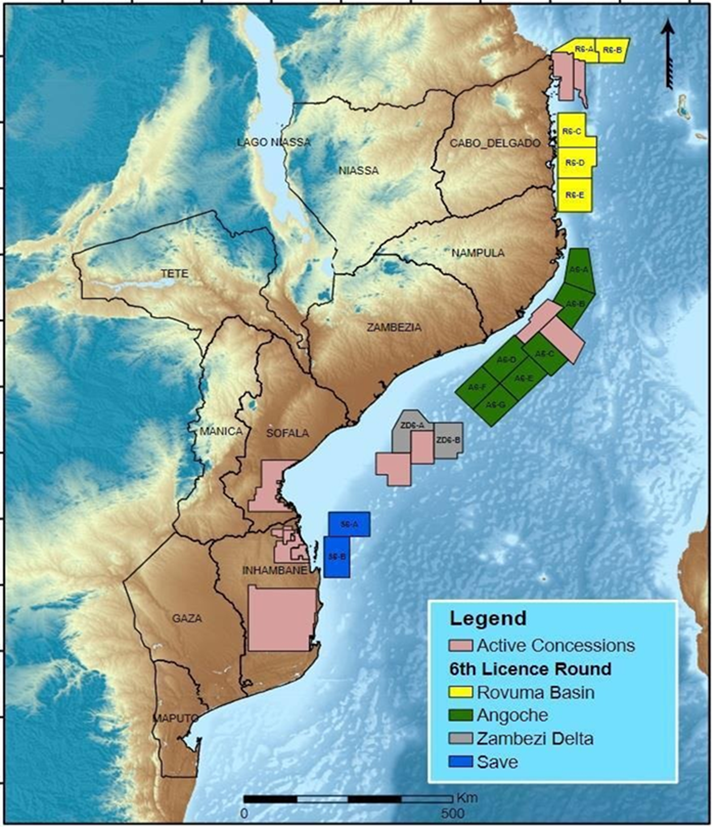
A 2012 USGS assessment of four East African geologic provinces—including Kenya, Tanzania, and Mozambique—estimated a mean 441.1 TCF of undiscovered technically recoverable natural gas, as ongoing exploration confirms the region is rapidly emerging as a major energy hub.
KINPRO has a deep historical footprint in Mozambique, having successfully localized anomalies that contributed to major gas discoveries in Area 1, Rovuma Basin, offshore Cabo Delgado, by Anadarko Petroleum, and supported the bid that resulted in the award of onshore Palmeira Area P5-A to Delonex Energy in Mozambique’s Fifth Public Concession Round. The 2026 Gaza Province program represents our current, self-funded multi-client initiative in the onshore southern region.
In 2026, KINPRO® continues to conduct preliminary, self-funded exploration work for natural gas in southern Mozambique, in Gaza Province (onshore), over an area of more than 13,000 km².
Preliminary satellite-survey results indicate highly promising exploration potential.
The following work has been carried out:
- A priori geological and geophysical materials on the Mozambique petroleum basin were studied.
- Geological and geophysical materials relating to the producing fields in the Mozambique petroleum basin — namely Pande and Temane — were studied.
- Stratigraphic materials relating to the Pande and Temane fields were studied, including the characteristics of the sedimentary rocks and reservoirs.
- Geophysical materials were acquired by remote sensing (satellite sensing) — gravity, magnetic, multispectral and hyperspectral surveys, and radar surveys — relating to Pande and Temane. Anomalies were identified and localized at these fields.
- INTEGRATED PROCESSING was performed on the satellite geophysical sensing materials (gravity and magnetic) for the area in Gaza Province where KINPRO is conducting its research in 2026, together with 2D seismic data for the Pande and Temane fields.
- Anomaly data from the Pande and Temane fields, adopted as BENCHMARK data for the processing, were transferred to the gas-bearing district in Gaza Province.
- The anomaly data were recomputed for the gas-bearing district in Gaza Province, covering an area of 13,000 km², with emphasis on the gravity and magnetic processing materials for this gas-bearing district obtained through satellite geophysical sensing.
- Based on the PRELIMINARY results obtained after processing and interpreting the materials, there is confidence that this gas-bearing district holds strong potential for further study by aerogeophysical methods, since in our assessment it may hold no less than 29–30 TCF of undiscovered gas initially in place (GIIP).
The data sources for our studies include:
- Multispectral and hyperspectral satellite imagery.
- Satellite-derived digital elevation models.
- Satellite-derived digital models of the Earth's gravity and magnetic fields.
- General geological and geophysical information.
- FSSAT analysis of satellite data.
- Additional satellite imagery types acquired on a fee basis as needed.
Specifically, by applying our proprietary methods of integrated processing of satellite geophysical data, we have localized geophysical anomalies interpreted as exploration indicators associated with prospective hydrocarbon accumulations (natural gas) within the study area.
The anomalies identified across the gas-bearing region of Gaza Province include:
- Density anomalies.
- "Mass-deficit" (gravity anomalies).
- Magnetic anomalies.
- Surface geochemical and spectral alteration anomalies driven by hydrocarbon micro-seepage.
- Anomalies specific to hydrocarbons or minerals identified with FSSAT.
- Micro-seepage anomalies.
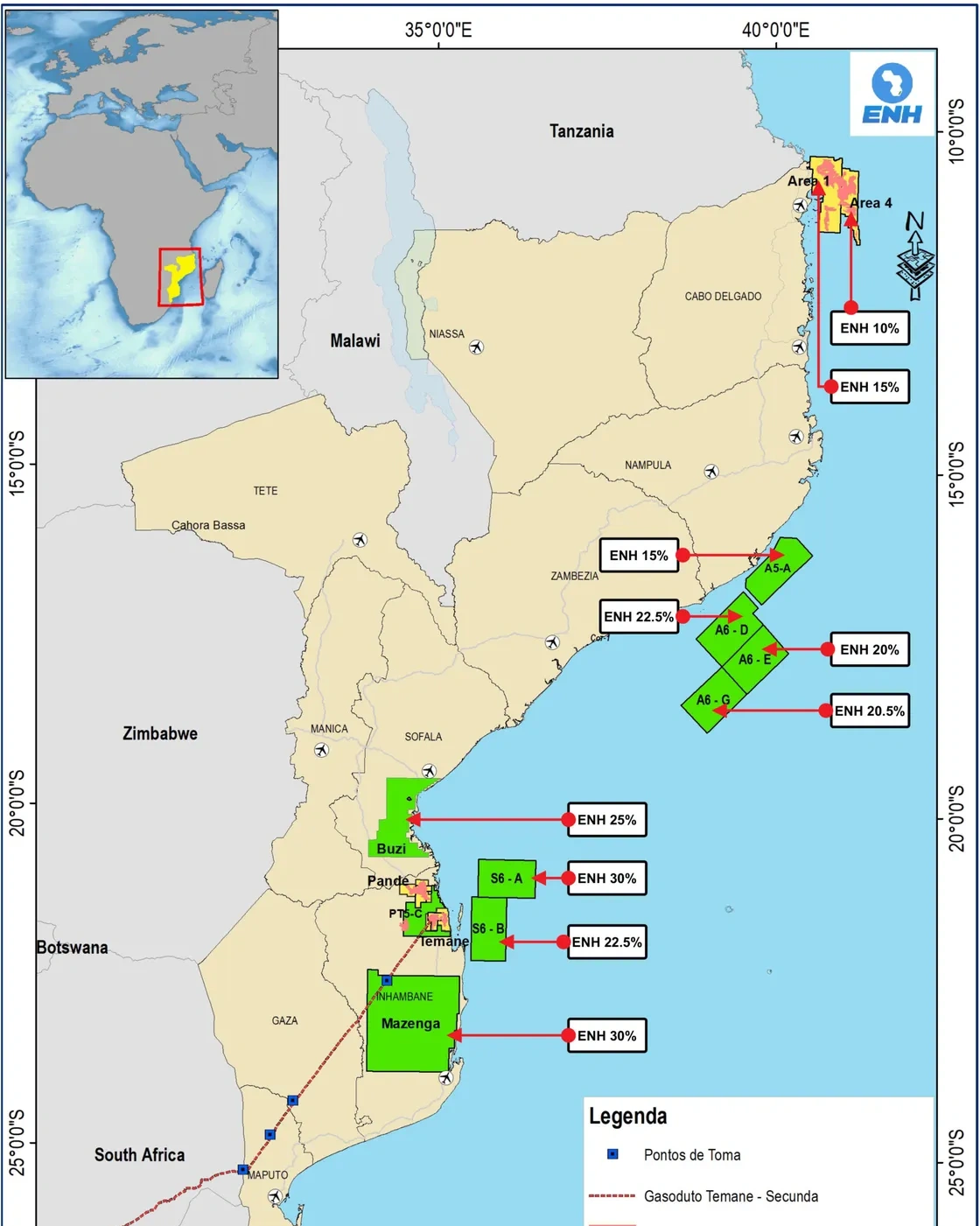
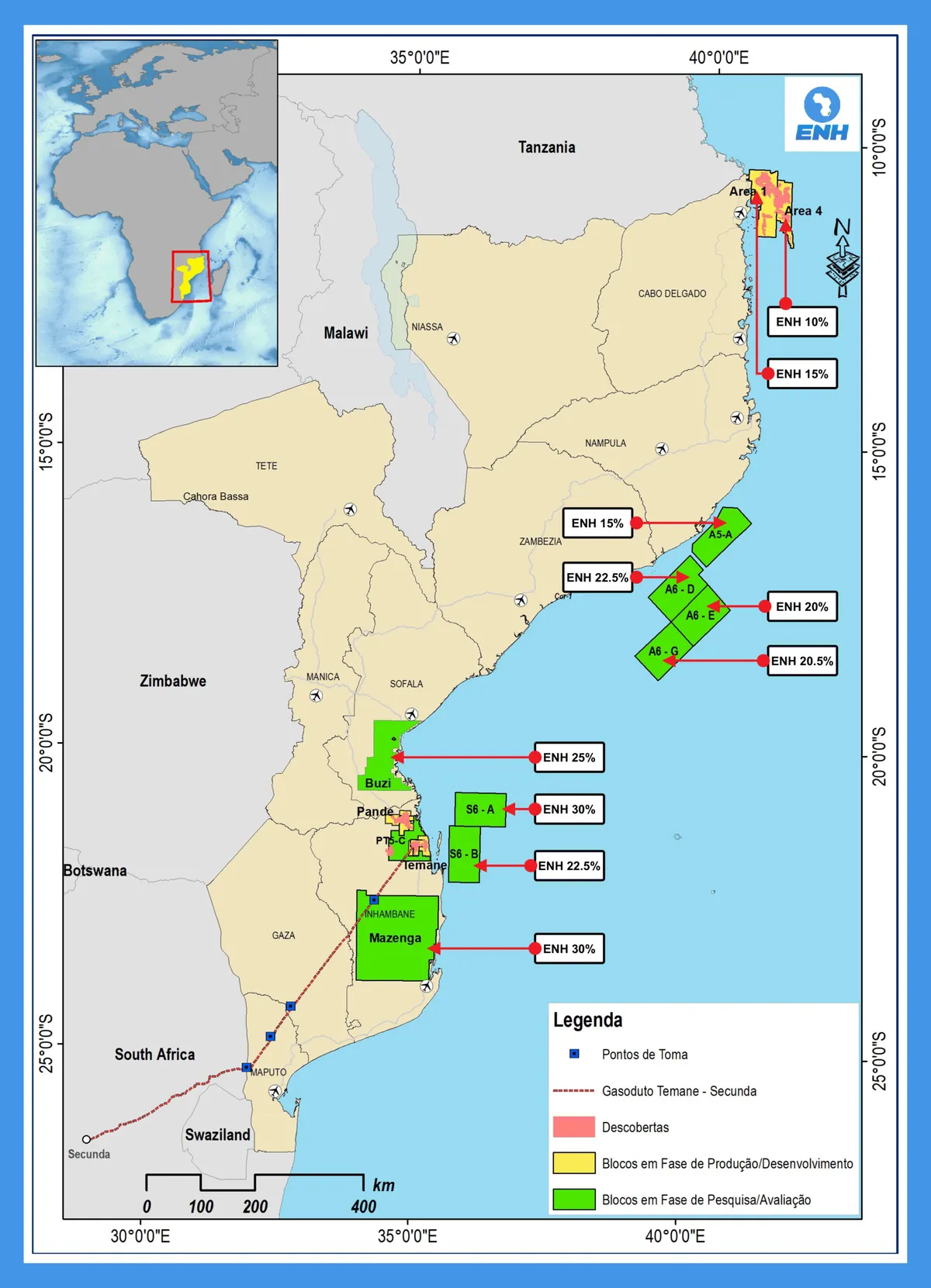
Licensed gas blocks, including the onshore blocks of the South Mozambican oil and gas basin (Source: https://enh.co.mz). KINPRO's 13,000 km² survey area is located within this same oil and gas basin.
One of important factors governing the formation of surface expressions of oil and gas accumulations is the micro-seepage of hydrocarbon emanations from traps into overlying strata along fault and fracture zones. The theory of hydrocarbon micro-seepage dates back to the 1980s.
Our satellite-based X-Vision and FSSAT methods—designed in part to detect the energy signatures of micro-seepage at the Earth's surface—are direct-detection methods, in that they point directly to anomalies indicating potential presence of hydrocarbons and mineral resources in the subsurface and to their electromagnetic and energetic activity.
By integrating high-resolution satellite-derived gravity and magnetic data with multispectral satellite sensing, KINPRO® has mapped a complex network of structural and stratigraphic anomalies in the Gaza Province. These satellite datasets have identified multiple large-scale, un-drilled structural closures with a high degree of geophysical confidence. Conceptual, risk-unadjusted volumetric estimates indicate that the identified prospect inventory may contain approximately 29–30 trillion cubic feet (TCF) of undiscovered gas initially in place (GIIP). This figure represents GIIP and should not be interpreted as an estimate of Prospective Resources under SPE-PRMS. The targets remain undrilled, and the presence, recoverability, and commercial viability of hydrocarbons have not yet been established. These factors would require further technical evaluation and exploratory drilling.
Gas-resource estimates were calculated and cross-checked using several proprietary methodologies.
In the assessment of international specialists and analysts, this district has the potential to become the largest gas-resource district on the African mainland, given that it contains several prospective targets holding large and medium volumes of natural gas.